
Getting Lines Right in A&NZ: Teams, Policies, and Practice
 "Getting Lines Right in A&NZ: Teams, Policies, and Practice")
Study Overview
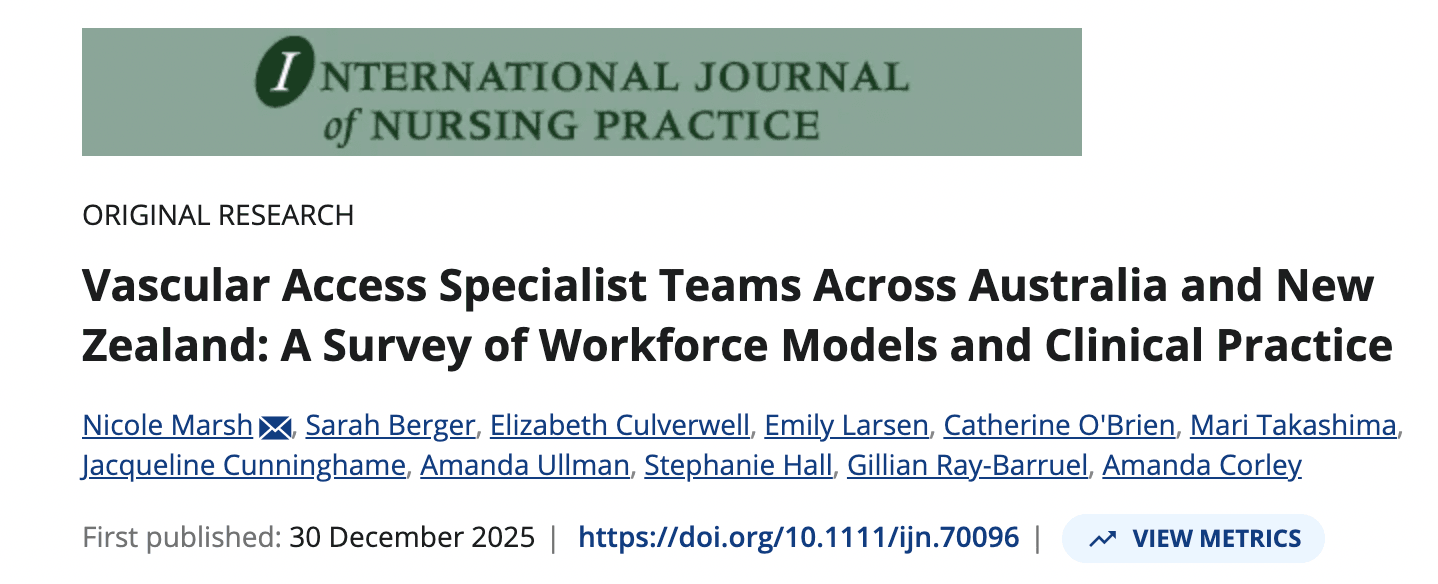
This cross-sectional survey captured how vascular access care is organized across Australian and New Zealand hospitals, focusing on whether facilities have a vascular access specialist team (VAST), who selects devices, and which practices/policies are in place. Responses from 237 clinicians described settings, team composition, escalation pathways for difficult IV access (DIVA), and availability/uptake of device types and techniques (e.g., ultrasound-guided PIVCs, midlines).
Key Findings
- VASTs are not universal: Only about one-third of responding facilities had a formal VAST, most commonly led by clinical nurse specialists/consultants.
- Who picks the device? Device selection was usually made by medical staff; fewer sites reported VAST-led selection.
- Better pathways where VASTs exist: Sites with VASTs were far more likely to have clear escalation processes for DIVA patients.
- Broader device mix with VASTs: Facilities with VASTs reported greater access to/usage of ultrasound-guided PIVCs and midline catheters.
- Staffing limits scale: Even where benefits were seen, constrained staffing curtailed wider implementation of VAST-driven practices.
Implications
- Make VASTs a capability multiplier: Dedicated teams correlate with stronger escalation pathways, a richer device toolbox (UG-PIVCs, midlines), and more evidence-based policy adoption.
- Share decision-making: Enabling trained VAST clinicians to lead or co-lead device selection can align choices with patient risk and site resources.
- Standardize and spread: Codify DIVA escalation, ultrasound guidance training, and midline pathways; then scale beyond early-adopter units.
- Resource the model: Ensure staffing and governance support so VAST benefits are sustained and available after hours and across wards.
- Measure and iterate: Audit insertion success, device failure, and patient experience to target education, procurement, and policy updates.
Read More:https://onlinelibrary.wiley.com/doi/10.1111/ijn.70096
Authors: Nicole Marsh; Sarah Berger; Elizabeth Culverwell; Emily Larsen; Catherine O’Brien; Mari Takashima; Jacqueline Cunninghame; Amanda Ullman; Stephanie Hall; Gillian Ray-Barruel; Amanda Corley.