
Infrared vs Palpation for Adult PIVCs: What the Evidence Really Shows
 "Infrared vs Palpation for Adult PIVCs: What the Evidence Really Shows")
Study Overview
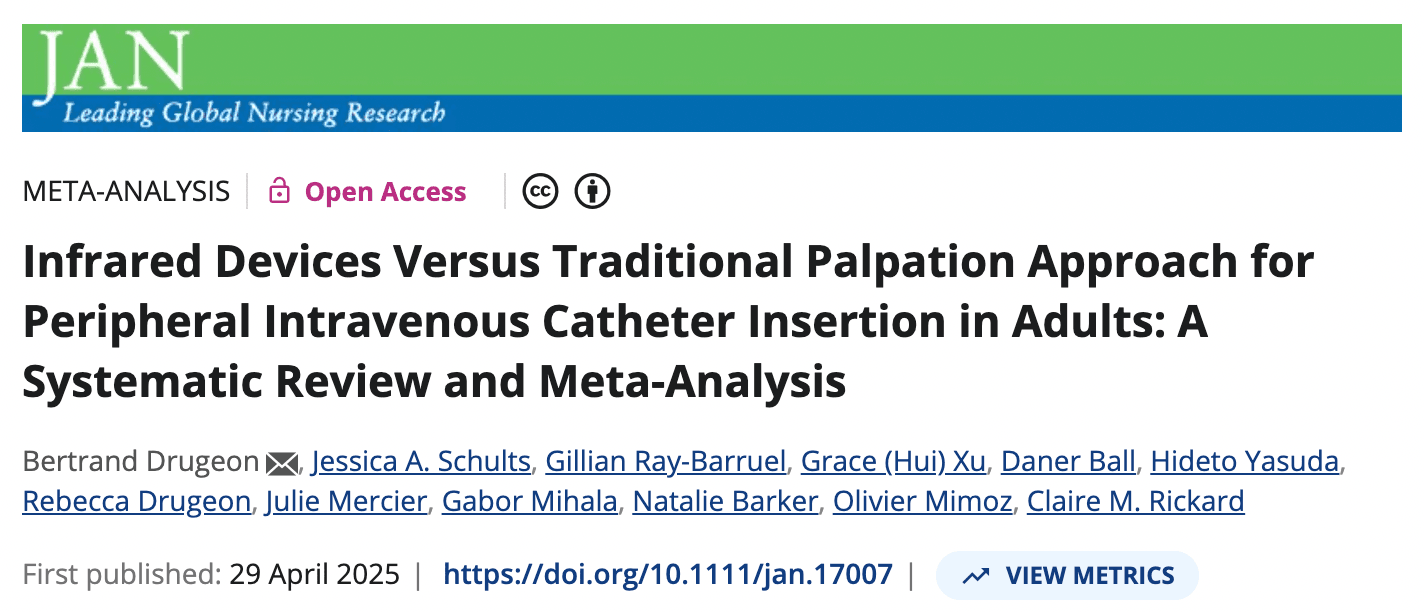
Peripheral IV cannulation is common—but repeat attempts are painful, time-consuming, and can increase complication risk. This systematic review and meta-analysis asked a simple question: Do infrared (IR) vein-visualisation devices improve PIVC insertion outcomes in adults compared with standard palpation/landmark technique?
The authors pooled 5 randomised controlled trials, covering 690 adults and 704 PIVC insertions (including 289 insertions in patients meeting DIVA criteria).
Key Findings
1. First-attempt success was similar
- IR devices: 42% (139/331)
- Traditional palpation: 38% (143/373)
- Overall effect: no meaningful advantage for IR devices.
2. Overall cannulation success was essentially identical
- Both groups achieved ~98% overall success when all attempts were allowed.
3. Number of attempts didn’t improve
- Average attempts were broadly similar between groups, with no clear reduction using IR.
4. Time to cannulate wasn’t faster
- Mean time was roughly 3-4 minutes in both groups, with no consistent time savings using IR.
5. Pain didn’t decrease (and may be slightly higher with IR)
- Across the limited pain data available, IR use did not reduce pain, and pooled results suggested a small increase.
Why the Results Matter
Infrared devices are attractive in theory—portable, easy to clean, and designed to “light up” superficial veins. But based on current adult RCT evidence, they don’t reliably deliver the outcomes clinicians and patients care about most: a higher first-stick success rate, fewer attempts, faster access, or less pain.
Practical Takeaways for Clinical Teams
Don’t expect IR devices to lift first-attempt success in routine adult cannulation.
Prioritise proven approaches for difficult acces early DIVA identification, escalation pathways, and ultrasound-guided insertion when indicated.
If your service is considering IR purchase, the evidence suggests it should be framed as optional/limited use, not a standard solution for improving adult PIVC success.
Where IR Might Still Have a Role
This review highlights gaps that matter for real-world decision-making:
- Outcomes weren’t consistently reported for DIVA subgroups, so we still don’t have strong answers for which specific adult populations might benefit most.
- Training and operator experience varied—future studies could clarify whether IR helps novice inserters or specific clinical contexts.
Read More:https://onlinelibrary.wiley.com/doi/10.1111/jan.17007
Authors: Bertrand Drugeon; Jessica A. Schults; Gillian Ray-Barruel; Grace (Hui) Xu; Daner Ball; Hideto Yasuda; Rebecca Drugeon; Julie Mercier; Gabor Mihala; Natalie Barker; Olivier Mimoz; Claire M. Rickard